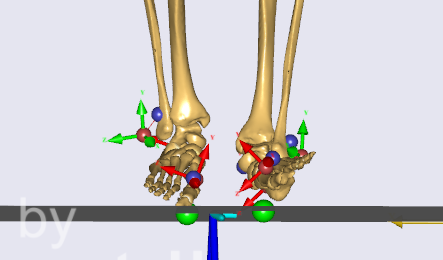
I had a problem with running one MoCap data for gait analysis. In the parameter identification stage, it showed: Kinematic analysis failed in time step 44 : Position analysis is not completed and broke down.
Then, I ran Marker Tracking. It failed to complete, with leaving the message: Kinematic analysis failed in time step 272 : Position analysis is not completed
An inverse dynamic analysis afterwards failed as well with message: No kinematic joint angle data available after t = 31.5s.
Please re-run the entire Marker Tracking first (or Main.RunAnalysis)
By the way, the ankle really did look strange. It had taken on a very odd angle, even though I had enabled the weak driver for the subtalar joint, just as we discussed in my last post with you.
I understand that this might be complicated. If you’d like, I can send you my .c3d file and all the modified AnyScripts. Just give me an email address.
Are you running parameter identification on the same motion trial that you want to analyze? Also is it only lower body or full body mocap data?
If you have a standing reference trial, can you try to run parameter identification on that? Otherwise, you can crop your motion trial to around 10-20 frames and run parameter identification on the cropped trial.
I don't think it's strange that marker tracking fails when parameter identification doesn't run. One other option you can try is increasing the weight of the weak mannequin driver for the subtalar joint.
thanks for your reply. I am running the parameter identification on the same motion trial that I try to analyse and there is no other calibration files (e.g. T pose) that I can use.
It is only lower body.
However, I followed your advice to cut the frames to only 20 and ran parameter identification again. This time it worked quite well. The strange subtalar angle disappered and program finished without problem, for parameter identification as well as following inverse dynamics.
I would like to know why it worked now when I cut only 20 frames to run parameter identification instead of with the whole trail data? Should I apply this method in principle to all my trial files in future to obtain a more stable simulation behavior (and maybe also a more precise result for kinematics and kinetics)?
That's great to know that you were able to solve the problem
The general guideline for parameter identification is to do it on a standing reference trial from the subject and load these parameters for all the motion trial by that subject. Since you don't have such a trial in your data, you can try to recreate a reference trial for each subject by cropping one of the motion trials and running parameter identification on it. Then you can reuse the saved parameters in the other trials by the same subject. In AnyBody the reference trial doesn't need to be any specific posture, but of course some are easier than others. In my experience T-pose is somewhat more challenging for parameter identification because of raised shoulders.
As to why parameter identification fails when you run it on the full motion is because of the optimization problem. It starts with the initial "guesses" of segment lengths and marker positions and runs several iterations to evaluate errors and optimize the parameters. It is an iterative process, but if the initial guesses are a bit too far, then it can simply fail to solve the motion in the first iteration itself at some point during the complete motion.
Moreover, running parameter identification on a short trial saves you time