I would like to perform a patient-specific analysis for the point-on-plane mandible model. I have already scaled the AnyBody mandible to my target patient mandible using Individualisation pipeline.However, I can see in the load case scenario (JointsandDrivers) there is a .txt file (e.g. ChewingRight.txt) that apply motion to one of the markers. Are these motions (Chewing and Clenching) still valid for the new model after scaling?
These data has been recorded for a specific person so it might not be representative for the chewing motion your subject. I think the applied force in the model was not measured but simply applied.
I am not an expert in the mandible model but I guess you can chew in many ways and if the subject is not too different it might be ok, but it would be better to measure it.
Thanks for quick reply. I have applied the chewing motion to the scaled model and visually it seems correct. It is good to mention that I used the Incisor node location (driver node for chewing) as a landmark point for AnyFunTransform3DLin2 and after the scaling process It seems that the location of this node is updated according to the performed scaling pipeline and is in the correct position for the scaled model (between two Incisor teeth). Therefore, one can conclude that the scaling function would be applied to nodes as well.
So what is a node indeed? it is a point with a definite position {x,y,z}. The motion .txt file also contains a lot of node positions for each time step:
{x1,y1,z1}
{x2,y2,z2}
{x3,y3,z3}
.
.
.
it would be great if we could somehow apply the scaling function to the motion as well? Is there any method to do that?
I think it will be possible technically to scale the motion data, but i my opinion it would not be very meaningful.
The only way to scale motion data would be to apply some scaling factor and possibly a translation, but it would not make it fit better to the subject.
What you could consider instead maybe would be to extract joint angles+ translations motion from the base model and apply the same joint angles + translations to your scaled model, so change the way the model is being driven.
I have solved the problem using another method like applying motion to a dummy node. I have performed your brilliant idea as well. Thank you so much. The only point regarding this idea is to be careful about the system degrees of freedom. Otherwise, one will receive error messages like "the model is kinematically indeterminate or over-constrained".
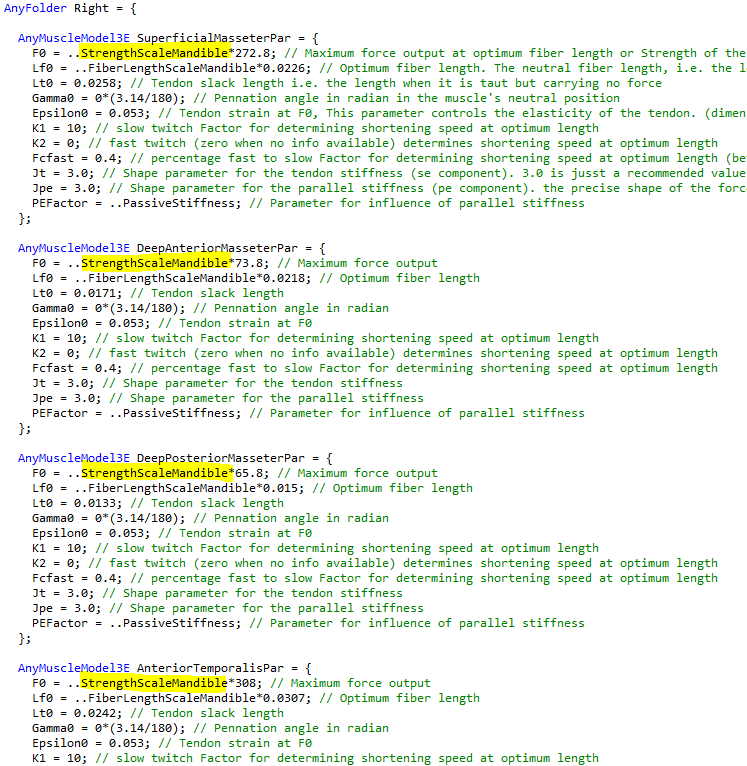
I would like to work on the muscles individualisation as well for my patient-specific mandible model. I can see that there are two scaling functions called FiberLengthScaling and StrengthScaling which are applied to the Lf0 and F0 parameters of AnyMuscleModel3E respectively, for each muscle. As far as I realised, other parameters are either calibrated after a calibration study or are constant values based on the literature and there is no need for tuning (Am I right?).
The question is how can I define scaling functions for muscle strength and fiberlength, suitable for my patinet-specific model? Is there any ((computational)) strategy? I don't have any information about my patient muscles but its geometry.
One strategy for the muscle strength scaling could be to achieve a certain amount of bite force, so adjust the model to reach an activation of one for a certain sized bite force.
Would you please elaborate more. There are a lot of muscles included in the model on both sides. For which one I should achieve the activation of one for a certain sized bite force?
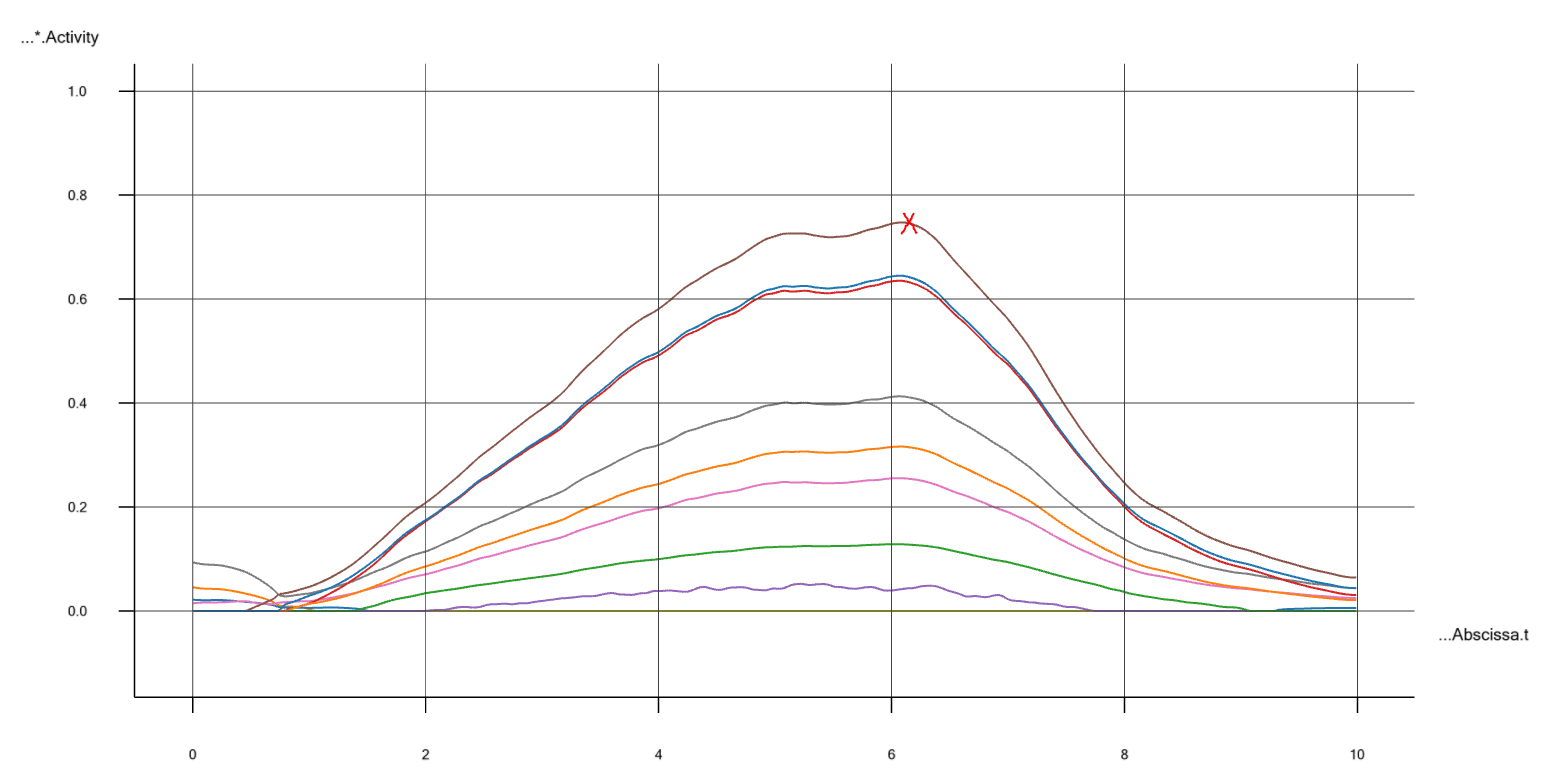
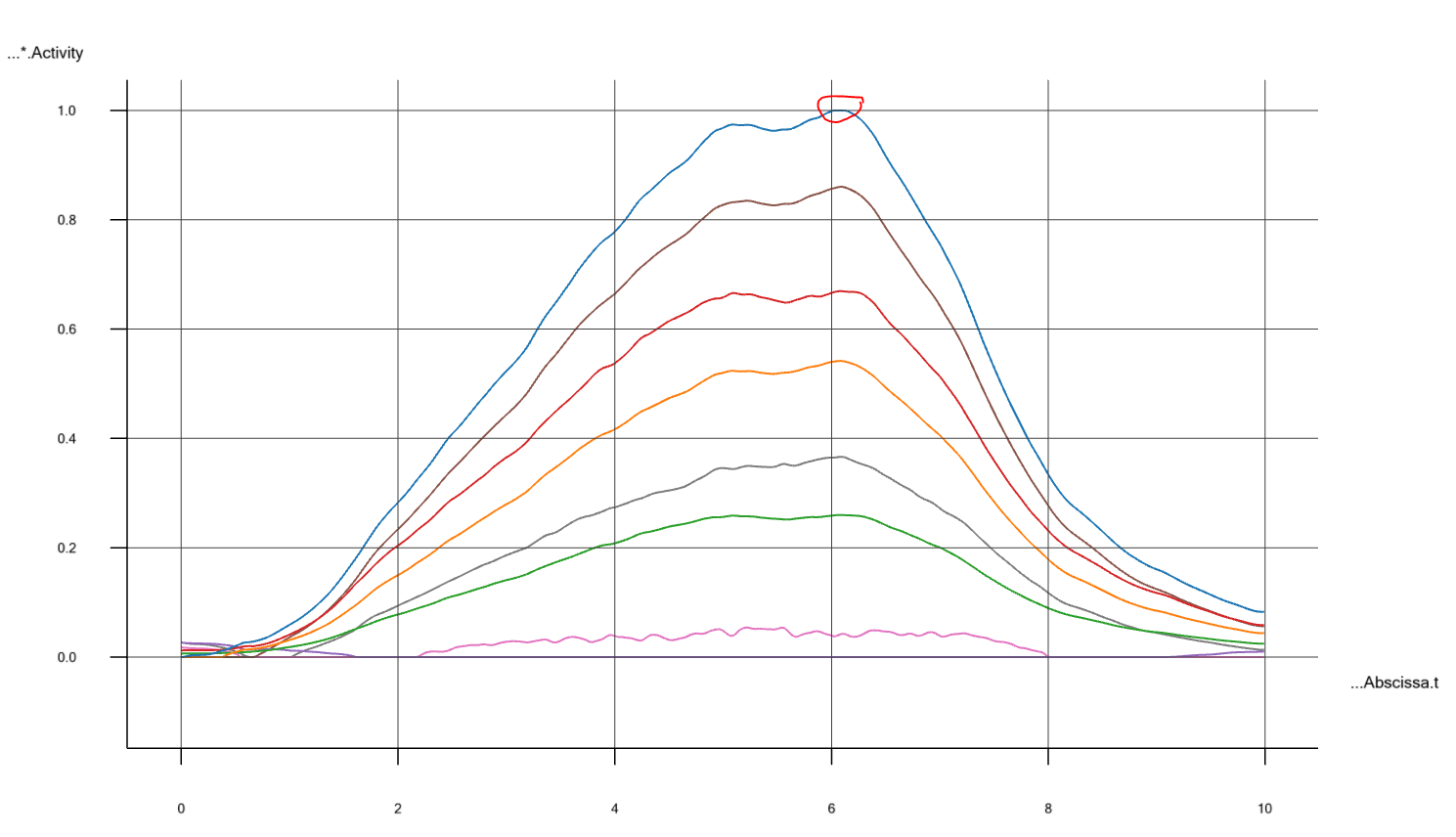
Also, I checked the original Anybody model and this is not the case for this model as the activity is not one for any muscle. The activity is 0.7474191 in the greatest case for the Left MedialPterygoid! as shown in the attached figure. if one change the StrengthScale to 0.75 then, the muscle activity of one would be achieved for MedialPterygoid.
I do not think that the loads applied in the AMMR model replicates exactly the maximum possible bite force, if that would have been the case the activity would have reached 1.
It is not a particular muscle which should be one it can be basically any one of them. I would introduce a factor in the muscles strength definition that would be shared for all muscles, to control the strength. Then apply the maximum force you would like the model to have. Then simply change the factor until one of the muscles reached one.
I would like to make sure if it is exactly what you have suggested in the previous message? Also, It would be great if you briefly explain what is the concept behind this idea (I mean reaching to muscle activity of 1)? Why this is a good method to find a good strength scale factor?
When the model reach an activity of 1 it means that one or several muscles have reached their maximum capability and is now the "bottleneck" in the model. So assuming the force applied to the model is the max bite force this is a way to scale muscles strengths to achieve this. If you want you can experiment with the recruitment settings of the study the MinMaxStrict criterium will extract the maximum strength out of your model.
This tutorial explains the meaning of the different settings: