Dear @msan00 and @laozilaozi ,
First thank you very much for your interest in this problem.
I checked for the mass and reducing it indeed creates a better match in single stance phase. What I did here is changing the BW from 66 to 60kg (but in the demo file it is not written anywhere what was the true BW of the subject). Then I ran the parameter identification, loaded the parameters, ran the analysis and extracted the vertical GRFs predicted with the new weight. Here is the result:
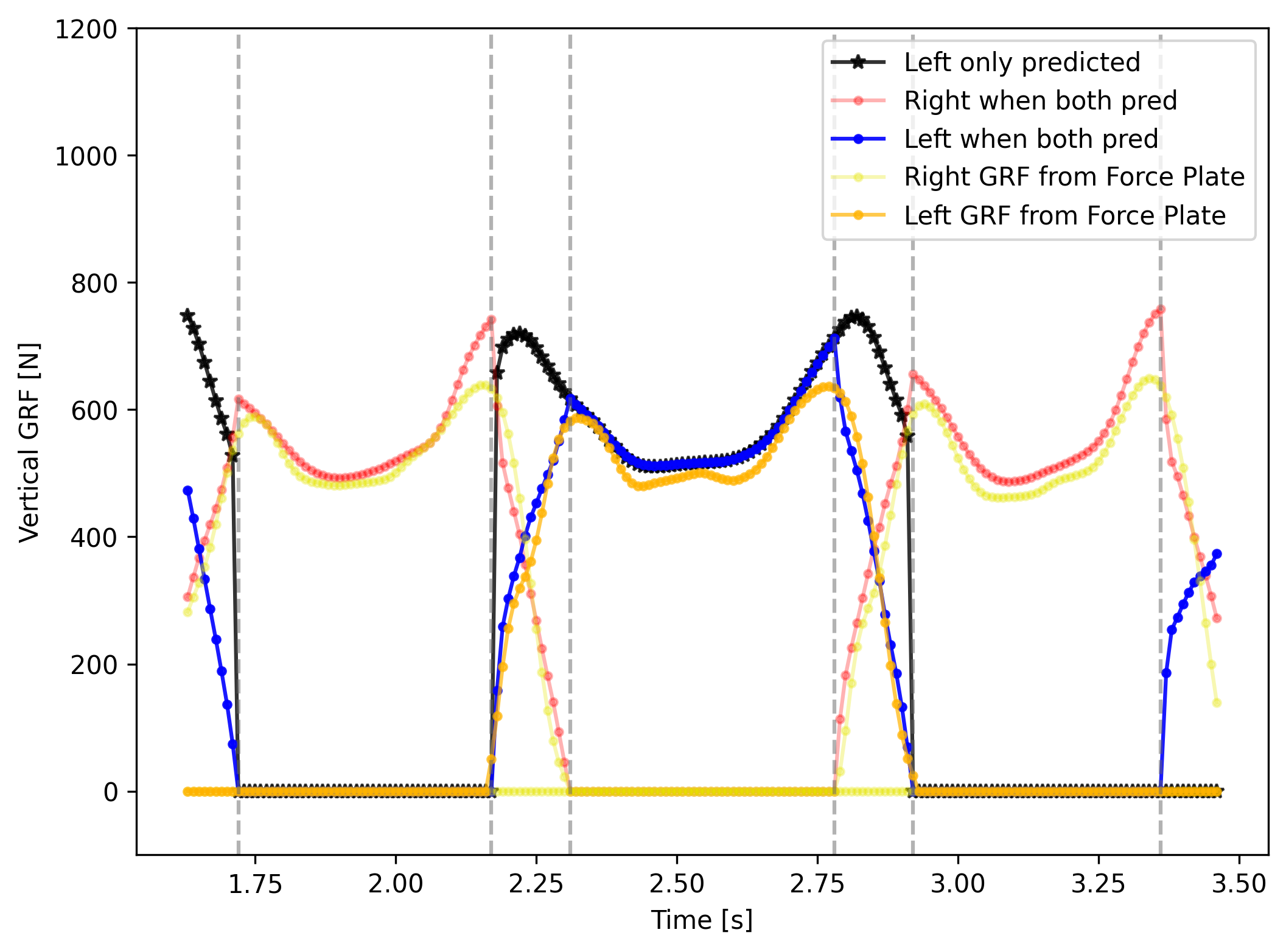
Trying with data from a subject of known mass, I did not have this offset in single stance. So the anthropometrics of the demo should be adjusted.
Another thing that seems incoherent is the mass of the subject. Indeed, in the anthropometrics it is set to 66kg, but after parameters identification and scaling, then it appears to be above 67kg in BodyModel folder. I also noted that for other data. As @laozilaozi suggested, this may affect mass repartition for the model and the derived kinematics and kinetics.
As you can see, we still have the overshoot at heel strike and toe off. Thank you @laozilaozi for the tip about the residuals here. I understand your suggestion about improving marker tracking and body mass distribution to reduce the residuals. However, I see some obstacles for that:
- First, the final goal of this algorithm to predict GRFs would be to use it without needing force plates (and so without measured data for which we could optimize the residuals of the model)
- Second, I do not see exactly how to improve those parameters for the demo since I did not find any information about the subject data was taken from.
- Thirdly, I ran this GRF measurements and predictions for different trials of diverse subjects and this problem is redundant for all the files. Maybe this suggest changes to be done in the core of model scaling technique ? In which case what better technique do you suggest?
It seems it is tricky to identify where the problem comes from, so thank you very much for your suggestions.
Bests,
Julie